In this post I will discuss the scenario where we want to send notification to user with User ID on successful account creation in OIM.

Enter the required details like
Template Name: Notify User(You can choose any name and the same needs to be referred in code)
Description Text: Notify User when User is Created in OIM
Available Event: Create User(WE will update this once we create a New Event)
Encoding: UTF-8
Message Subject: Congratulations! Your Account has been successfully Created
Type: HTML
Short Message: Create User Successful(Change it as per your Notification requirement)
Long Message:
<html><head></head> <body>
<p>
Congratulations!! Your account has been successfully created!!
Your user login is - $userLoginId
</p>
</body></html>
Click Save after providing the details, template will look as below:

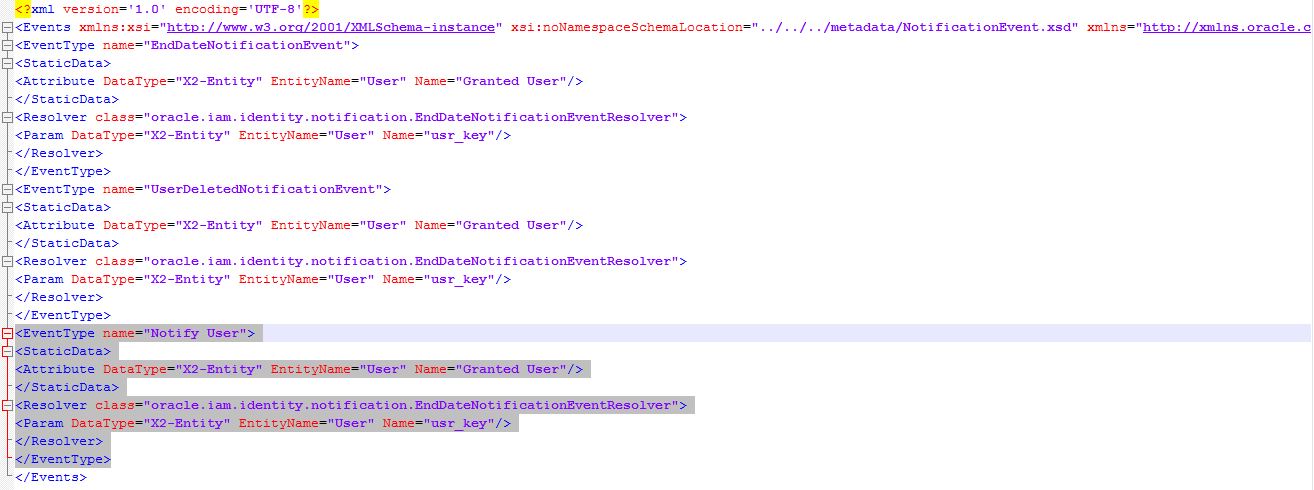
Now, we will create the event so that the same can be selected in the Notification Template. For that first we need to export the metadata. In that open the file metadata->iam-features-identity->IdentityNotificationEvent.xml. Add the below lines in the file:
<EventType name="Notify User">
<StaticData>
<Attribute DataType="X2-Entity" EntityName="User" Name="Granted User"/>
</StaticData>
<Resolver class="oracle.iam.identity.notification.EndDateNotificationEventResolver">
<Param DataType="X2-Entity" EntityName="User" Name="usr_key"/>
</Resolver>
</EventType>
Screenshot is attached for reference below:

Now save the file and import the metadata. Once the import is completed, now we can see the "Notify User" event in the template, select it and save the template as below:

Now, we need to write the code which uses the above template to send Notification to user once the user is created in OIM. For that we have 2 broadly classified scenarios:
1. User Created Using Identity Console
2. User Created Using Flat File
In our code we will write the code to take care of both the cases, you can choose both or one as per the requirement. Read the comments above method to understand the role of each method. We need to 2 jar files for this code namely oimclient.jar and ojdl.jar. Below is the code:
package com.handler.iam;
import java.io.Serializable;
import java.util.ArrayList;
import java.util.HashMap;
import java.util.HashSet;
import java.util.List;
import java.util.Set;
import oracle.core.ojdl.logging.ODLLogger;
import static oracle.iam.identity.usermgmt.api.UserManagerConstants.AttributeName.MANAGER_KEY;
import static oracle.iam.identity.usermgmt.api.UserManagerConstants.AttributeName.USER_LOGIN;
import oracle.iam.identity.exception.AccessDeniedException;
import oracle.iam.identity.exception.NoSuchUserException;
import oracle.iam.identity.exception.UserLookupException;
import oracle.iam.identity.usermgmt.api.UserManager;
import oracle.iam.identity.usermgmt.vo.User;
import oracle.iam.notification.api.NotificationService;
import oracle.iam.notification.vo.NotificationEvent;
import oracle.iam.platform.Platform;
import oracle.iam.platform.kernel.spi.PostProcessHandler;
import oracle.iam.platform.kernel.vo.AbstractGenericOrchestration;
import oracle.iam.platform.kernel.vo.BulkEventResult;
import oracle.iam.platform.kernel.vo.BulkOrchestration;
import oracle.iam.platform.kernel.vo.EventResult;
import oracle.iam.platform.kernel.vo.Orchestration;
import oracle.iam.upgrade.metadata.Params;
public class userCreationNotification implements PostProcessHandler{
private ODLLogger logger = ODLLogger.getODLLogger("com.scb.oim.generateEmailID");
/**
* This method is used to send Notification to user when User is created using Identity Screen of OIM
* @param processId
* @param eventId
* @param orchestration
* @return
*/
public EventResult execute(long processId, long eventId, Orchestration orchestration) {
logger.entering("Notification", "EventResult execute");
try {
logger.info("Entering EventResult of NotifyUserIdToUser");
logger.info("Process ID ->" + processId);
logger.info("Event ID ->" + eventId);
String oprType = orchestration.getOperation();
logger.info("oprType ->" + oprType);
HashMap<String, Serializable> Params = orchestration.getParameters();
//logger.info("Param ->" + Params);
Set<String> KeySet = Params.keySet();
//logger.info("KeySet ->" + KeySet);
String usrLogin = null;
String usrKey = null;
for (String key : KeySet) {
logger.info("key ->" + key);
Serializable serializable = Params.get(key);
logger.info("serializable ->" + serializable);
if (key.equalsIgnoreCase("User Login")) {
usrLogin = serializable.toString();
logger.info("usrLogin ->" + usrLogin);
UserManager usrMgr = Platform
.getService(UserManager.class);
User user = usrMgr.getDetails(usrLogin, null, true);
usrKey = user.getEntityId(); // getAttribute("usr_key").toString();
String uid = user.getId();
logger.info("uid--->" + uid);
logger.info("usrKey ->" + usrKey);
String templateName = "Notify User";
NotificationService notService = Platform
.getService(NotificationService.class);
NotificationEvent eventToSend = this
.createNotificationEvent(templateName, usrKey);
notService.notify(eventToSend);
}
}
} catch (Exception e) {
logger.info("exception e in ExecuteEvent ->"
+ e.getMessage());
e.printStackTrace();
}
logger.exiting("Notification", "ExecuteEvent");
return new EventResult();
}
/**
* This method is used to create the Notification Event using the Template Name and User Key
* @param poTemplateName
* @param userKey
* @return
*/
private NotificationEvent createNotificationEvent(String poTemplateName, String userKey) {
logger.entering("Notification", "createNotificationEvent()");
NotificationEvent event = null;
try {
event = new NotificationEvent();
String[] receiverUserIds = getRecipientUserIds(userKey);
event.setUserIds(receiverUserIds);
event.setTemplateName(poTemplateName);
event.setSender(null);
logger.info("User ID: "+receiverUserIds.toString());
logger.info("Template Name: "+poTemplateName);
HashMap<String, Object> templateParams = new HashMap<String, Object>();
templateParams.put("usr_key", userKey);
event.setParams(templateParams);
logger.exiting("Notification", "createNotificationEvent()");
} catch (Exception e) {
e.printStackTrace();
logger.severe("Exception in createNotificationEvent()"+e.getMessage());
}
return event;
}
/**
* This method is used to send Notification to user when User is created using BulkUpload or Flat File
* @param l
* @param l1
* @param bulkOrchestration
* @return
*/
public BulkEventResult execute(long l, long l1,
BulkOrchestration bulkOrchestration) {
logger.entering("Notification", "Bulk User Creation");
try {
logger.info("Entering BulkEventResult of NotifyUserIdToUser");
logger.info("l ->" + l);
logger.info("l1 ->" + l1);
String oprType = bulkOrchestration.getOperation();
logger.info("oprType ->" + oprType);
HashMap<String, Serializable>[] bulkParams = bulkOrchestration.getBulkParameters();
for (HashMap<String, Serializable> bulkParam : bulkParams) {
logger.info("bulkParam ->" + bulkParam);
Set<String> bulkKeySet = bulkParam.keySet();
logger.info("bulkKeySet ->" + bulkKeySet);
String usrLogin = null;
String usrKey = null;
for (String key : bulkKeySet) {
logger.info("key ->" + key);
Serializable serializable = bulkParam.get(key);
logger.info("serializable ->" + serializable);
if (key.equalsIgnoreCase("User Login")) {
usrLogin = serializable.toString();
logger.info("usrLogin ->" + usrLogin);
UserManager usrMgr = Platform
.getService(UserManager.class);
User user = usrMgr.getDetails(usrLogin, null, true);
usrKey = user.getEntityId(); // getAttribute("usr_key").toString();
String uid = user.getId();
logger.info("uid--->" + uid);
logger.info("usrKey ->" + usrKey);
String templateName = "Notify User";
NotificationService notService = Platform
.getService(NotificationService.class);
NotificationEvent eventToSend = this
.createNotificationEvent(templateName, usrKey);
notService.notify(eventToSend);
}
}
}
} catch (Exception e) {
logger.info("exception e in BulkExecuteEvent ->"
+ e.getMessage());
e.printStackTrace();
}
logger.exiting("Notification", "Bulk User Creation");
return new BulkEventResult();
}
/**
* This method is used to fetch the UserID of the reciepient to whom the Notification needs to be sent
* @param userKey
* @return
* @throws NoSuchUserException
* @throws UserLookupException
* @throws AccessDeniedException
*/
private String[] getRecipientUserIds(String userKey) throws NoSuchUserException, UserLookupException, AccessDeniedException {
UserManager usrMgr = Platform.getService(UserManager.class);
User user = null;
String userId = null;
Set<String> userRetAttrs = new HashSet<String>();
userRetAttrs.add(MANAGER_KEY.getId());
userRetAttrs.add(USER_LOGIN.getId());
User manager = null;
String managerId = null;
String managerKey = null;
Set<String> managerRetAttrs = new HashSet<String>();
managerRetAttrs.add(USER_LOGIN.getId());
user = usrMgr.getDetails(userKey, userRetAttrs, false);
userId = user.getAttribute(USER_LOGIN.getId()).toString();
List<String> userIds = new ArrayList<String>();
userIds.add(userId);
if (user.getAttribute(MANAGER_KEY.getId()) != null) {
managerKey = user.getAttribute(MANAGER_KEY.getId()).toString();
manager = usrMgr.getDetails(managerKey, managerRetAttrs, false);
managerId = manager.getAttribute(USER_LOGIN.getId()).toString();
userIds.add(managerId);
}
String[] recipientIDs = userIds.toArray(new String[0]);
return recipientIDs;
}
public boolean cancel(long l, long l1,
AbstractGenericOrchestration abstractGenericOrchestration) {
return false;
}
public void initialize(HashMap<String, String> hashMap) {
}
public void compensate(long l, long l1,
AbstractGenericOrchestration abstractGenericOrchestration) {
}
}
We have an out-of-box notification as well for the same, where a mail is sent to user with User ID and password.
Now in this post we will achieve the same, but only User ID will be sent to the user in the notification. But we will discuss on how we can send other desired attributes as well using OIM APIs i.e the same code can be used to send other details as well which we will discuss side-by-side.
To start with, we first need to create a Notification Template that will be used to send notification to end-user. For that click on Notification on Administrator Control present under System configurations tab as shown below:
Click on Notifications and a popup window will appear. Click on Create New Notification's Icon to create New Notification Template as below:


Enter the required details like
Template Name: Notify User(You can choose any name and the same needs to be referred in code)
Description Text: Notify User when User is Created in OIM
Available Event: Create User(WE will update this once we create a New Event)
Encoding: UTF-8
Message Subject: Congratulations! Your Account has been successfully Created
Type: HTML
Short Message: Create User Successful(Change it as per your Notification requirement)
Long Message:
<html><head></head> <body>
<p>
Congratulations!! Your account has been successfully created!!
Your user login is - $userLoginId
</p>
</body></html>
Click Save after providing the details, template will look as below:

Now, we will create the event so that the same can be selected in the Notification Template. For that first we need to export the metadata. In that open the file metadata->iam-features-identity->IdentityNotificationEvent.xml. Add the below lines in the file:
<EventType name="Notify User">
<StaticData>
<Attribute DataType="X2-Entity" EntityName="User" Name="Granted User"/>
</StaticData>
<Resolver class="oracle.iam.identity.notification.EndDateNotificationEventResolver">
<Param DataType="X2-Entity" EntityName="User" Name="usr_key"/>
</Resolver>
</EventType>
Screenshot is attached for reference below:
Now save the file and import the metadata. Once the import is completed, now we can see the "Notify User" event in the template, select it and save the template as below:

Now, we need to write the code which uses the above template to send Notification to user once the user is created in OIM. For that we have 2 broadly classified scenarios:
1. User Created Using Identity Console
2. User Created Using Flat File
In our code we will write the code to take care of both the cases, you can choose both or one as per the requirement. Read the comments above method to understand the role of each method. We need to 2 jar files for this code namely oimclient.jar and ojdl.jar. Below is the code:
package com.handler.iam;
import java.io.Serializable;
import java.util.ArrayList;
import java.util.HashMap;
import java.util.HashSet;
import java.util.List;
import java.util.Set;
import oracle.core.ojdl.logging.ODLLogger;
import static oracle.iam.identity.usermgmt.api.UserManagerConstants.AttributeName.MANAGER_KEY;
import static oracle.iam.identity.usermgmt.api.UserManagerConstants.AttributeName.USER_LOGIN;
import oracle.iam.identity.exception.AccessDeniedException;
import oracle.iam.identity.exception.NoSuchUserException;
import oracle.iam.identity.exception.UserLookupException;
import oracle.iam.identity.usermgmt.api.UserManager;
import oracle.iam.identity.usermgmt.vo.User;
import oracle.iam.notification.api.NotificationService;
import oracle.iam.notification.vo.NotificationEvent;
import oracle.iam.platform.Platform;
import oracle.iam.platform.kernel.spi.PostProcessHandler;
import oracle.iam.platform.kernel.vo.AbstractGenericOrchestration;
import oracle.iam.platform.kernel.vo.BulkEventResult;
import oracle.iam.platform.kernel.vo.BulkOrchestration;
import oracle.iam.platform.kernel.vo.EventResult;
import oracle.iam.platform.kernel.vo.Orchestration;
import oracle.iam.upgrade.metadata.Params;
public class userCreationNotification implements PostProcessHandler{
private ODLLogger logger = ODLLogger.getODLLogger("com.scb.oim.generateEmailID");
/**
* This method is used to send Notification to user when User is created using Identity Screen of OIM
* @param processId
* @param eventId
* @param orchestration
* @return
*/
public EventResult execute(long processId, long eventId, Orchestration orchestration) {
logger.entering("Notification", "EventResult execute");
try {
logger.info("Entering EventResult of NotifyUserIdToUser");
logger.info("Process ID ->" + processId);
logger.info("Event ID ->" + eventId);
String oprType = orchestration.getOperation();
logger.info("oprType ->" + oprType);
HashMap<String, Serializable> Params = orchestration.getParameters();
//logger.info("Param ->" + Params);
Set<String> KeySet = Params.keySet();
//logger.info("KeySet ->" + KeySet);
String usrLogin = null;
String usrKey = null;
for (String key : KeySet) {
logger.info("key ->" + key);
Serializable serializable = Params.get(key);
logger.info("serializable ->" + serializable);
if (key.equalsIgnoreCase("User Login")) {
usrLogin = serializable.toString();
logger.info("usrLogin ->" + usrLogin);
UserManager usrMgr = Platform
.getService(UserManager.class);
User user = usrMgr.getDetails(usrLogin, null, true);
usrKey = user.getEntityId(); // getAttribute("usr_key").toString();
String uid = user.getId();
logger.info("uid--->" + uid);
logger.info("usrKey ->" + usrKey);
String templateName = "Notify User";
NotificationService notService = Platform
.getService(NotificationService.class);
NotificationEvent eventToSend = this
.createNotificationEvent(templateName, usrKey);
notService.notify(eventToSend);
}
}
} catch (Exception e) {
logger.info("exception e in ExecuteEvent ->"
+ e.getMessage());
e.printStackTrace();
}
logger.exiting("Notification", "ExecuteEvent");
return new EventResult();
}
/**
* This method is used to create the Notification Event using the Template Name and User Key
* @param poTemplateName
* @param userKey
* @return
*/
private NotificationEvent createNotificationEvent(String poTemplateName, String userKey) {
logger.entering("Notification", "createNotificationEvent()");
NotificationEvent event = null;
try {
event = new NotificationEvent();
String[] receiverUserIds = getRecipientUserIds(userKey);
event.setUserIds(receiverUserIds);
event.setTemplateName(poTemplateName);
event.setSender(null);
logger.info("User ID: "+receiverUserIds.toString());
logger.info("Template Name: "+poTemplateName);
HashMap<String, Object> templateParams = new HashMap<String, Object>();
templateParams.put("usr_key", userKey);
event.setParams(templateParams);
logger.exiting("Notification", "createNotificationEvent()");
} catch (Exception e) {
e.printStackTrace();
logger.severe("Exception in createNotificationEvent()"+e.getMessage());
}
return event;
}
/**
* This method is used to send Notification to user when User is created using BulkUpload or Flat File
* @param l
* @param l1
* @param bulkOrchestration
* @return
*/
public BulkEventResult execute(long l, long l1,
BulkOrchestration bulkOrchestration) {
logger.entering("Notification", "Bulk User Creation");
try {
logger.info("Entering BulkEventResult of NotifyUserIdToUser");
logger.info("l ->" + l);
logger.info("l1 ->" + l1);
String oprType = bulkOrchestration.getOperation();
logger.info("oprType ->" + oprType);
HashMap<String, Serializable>[] bulkParams = bulkOrchestration.getBulkParameters();
for (HashMap<String, Serializable> bulkParam : bulkParams) {
logger.info("bulkParam ->" + bulkParam);
Set<String> bulkKeySet = bulkParam.keySet();
logger.info("bulkKeySet ->" + bulkKeySet);
String usrLogin = null;
String usrKey = null;
for (String key : bulkKeySet) {
logger.info("key ->" + key);
Serializable serializable = bulkParam.get(key);
logger.info("serializable ->" + serializable);
if (key.equalsIgnoreCase("User Login")) {
usrLogin = serializable.toString();
logger.info("usrLogin ->" + usrLogin);
UserManager usrMgr = Platform
.getService(UserManager.class);
User user = usrMgr.getDetails(usrLogin, null, true);
usrKey = user.getEntityId(); // getAttribute("usr_key").toString();
String uid = user.getId();
logger.info("uid--->" + uid);
logger.info("usrKey ->" + usrKey);
String templateName = "Notify User";
NotificationService notService = Platform
.getService(NotificationService.class);
NotificationEvent eventToSend = this
.createNotificationEvent(templateName, usrKey);
notService.notify(eventToSend);
}
}
}
} catch (Exception e) {
logger.info("exception e in BulkExecuteEvent ->"
+ e.getMessage());
e.printStackTrace();
}
logger.exiting("Notification", "Bulk User Creation");
return new BulkEventResult();
}
/**
* This method is used to fetch the UserID of the reciepient to whom the Notification needs to be sent
* @param userKey
* @return
* @throws NoSuchUserException
* @throws UserLookupException
* @throws AccessDeniedException
*/
private String[] getRecipientUserIds(String userKey) throws NoSuchUserException, UserLookupException, AccessDeniedException {
UserManager usrMgr = Platform.getService(UserManager.class);
User user = null;
String userId = null;
Set<String> userRetAttrs = new HashSet<String>();
userRetAttrs.add(MANAGER_KEY.getId());
userRetAttrs.add(USER_LOGIN.getId());
User manager = null;
String managerId = null;
String managerKey = null;
Set<String> managerRetAttrs = new HashSet<String>();
managerRetAttrs.add(USER_LOGIN.getId());
user = usrMgr.getDetails(userKey, userRetAttrs, false);
userId = user.getAttribute(USER_LOGIN.getId()).toString();
List<String> userIds = new ArrayList<String>();
userIds.add(userId);
if (user.getAttribute(MANAGER_KEY.getId()) != null) {
managerKey = user.getAttribute(MANAGER_KEY.getId()).toString();
manager = usrMgr.getDetails(managerKey, managerRetAttrs, false);
managerId = manager.getAttribute(USER_LOGIN.getId()).toString();
userIds.add(managerId);
}
String[] recipientIDs = userIds.toArray(new String[0]);
return recipientIDs;
}
public boolean cancel(long l, long l1,
AbstractGenericOrchestration abstractGenericOrchestration) {
return false;
}
public void initialize(HashMap<String, String> hashMap) {
}
public void compensate(long l, long l1,
AbstractGenericOrchestration abstractGenericOrchestration) {
}
}
Since this is a post-process Event Handler, which we need to attach to Create User Process, we will do the same by creating a EventHandler.xml file will below lines:
<eventhandlers xmlns="http://www.oracle.com/schema/oim/platform/kernel" xmlns:xsi="http://www.w3.org/2001/XMLSchema-instance" xsi:schemaLocation="http://www.oracle.com/schema/oim/platform/kernel orchestration-handlers.xsd">
<action-handler class="com.handler.iam.userCreationNotification" entity-type="User" operation="CREATE" name="NotifyUser" stage="postprocess" order="FIRST" sync="TRUE"/>
</eventhandlers>
Now create a plugin.xml file with below lines:
<?xml version="1.0" encoding="UTF-8"?>
<oimplugins>
<plugins pluginpoint="oracle.iam.platform.kernel.spi.EventHandler">
<plugin pluginclass=
"com.handler.iam.userCreationNotification"
version="1.0"
name="userCreationNotification">
</plugin>
</plugins>
</oimplugins>
Now, deploy the EventHandler using ant plugin utility and the you will see that the Notification is being sent to user with User ID every time a new user is created in OIM. We can also send other attributes as per our requirement. For that we just need to add the Variables to Notification template using $ sign as we did for $userLoginId post that we have to select the variable from the list of variables already been fetched in the code and map it to that data to send it in Notification. If you still face issues you can contact me.
